
Turf Burn: Treatment, Time for Healing and Symptoms of Infection
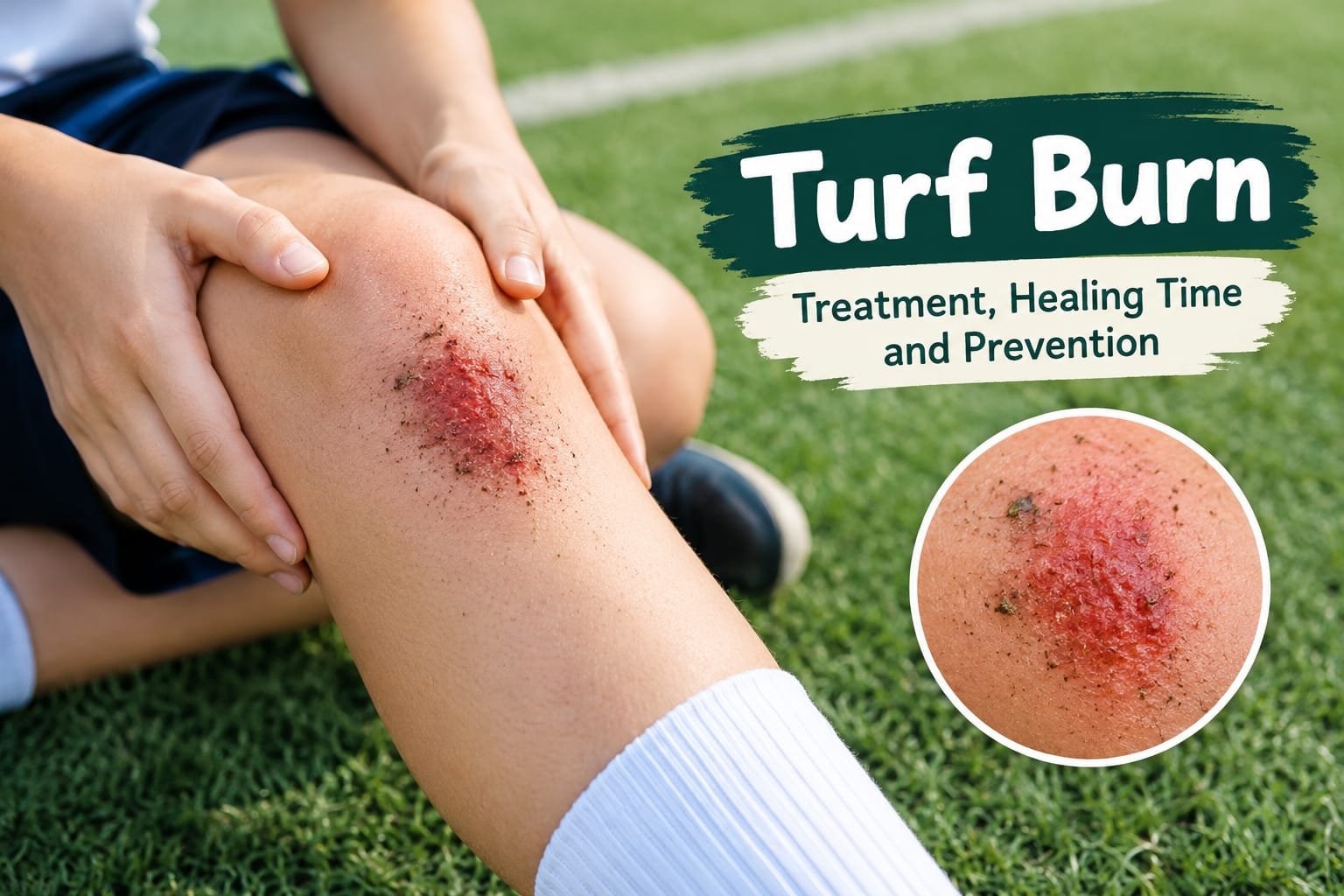
Turf Burn: Treatment, Healing Time and Prevention
Turf burn is a painful skin injury that can occur as a result of falling or sliding on artificial grass. Typically, this condition is diagnosed in people who participate in such sports as football, soccer, and rugby. In this case, the rough surface of the grass rubs off the top layer of the skin. As a result, one gets a red and irritated wound that resembles a raspberry.
Though it can seem rather minor, it is usually very painful. In addition to this, there can be some dirt, rubber, and plastic fibers under the wound that can cause an infection if the wound is not treated properly. A damaged skin barrier can also make the skin more sensitive, so proper wound care is important to protect the skin and support healing.
Fortunately, a great number of turf burns can be healed with appropriate treatment. In this article, we are going to tell you more about the causes, treatment, and healing time of turf burns, as well as about the signs of infection.
Causes of Turf Burn
As we have mentioned above, it is caused by friction. The rough surface of artificial grass rubs off the top layers of dirt and sweat may also make the area harder to clean.
Turf burn commonly affects these body parts:
- Knees
- Shins and lower legs
- Thighs and hips
- Elbows
- Forearms and hands
The injury may happen during a match, practice, or any activity where your skin touches the ground at speed.
What Does Turf Burn Look Like?
It is usually described as a red or pink abrasion. The affected skin is often characterized by being raw-looking, wet and rubbed off. Sometimes there may be a small amount of bleeding or even small pieces of dirt.
Some of the common symptoms are:
- Red or pink skin
- Burning sensation or stinging
- Swelling
- Bleeding from the scraped place
- Pain while moving the clothes over the wound
- Pieces of rubber and dirt stuck to the skin
The pain can worsen with washing the area and movement of the affected limb. In case of severe and extensive injuries, it is necessary to consult the doctor.
Turf Burn Treatment: What Should You Do First?
Correctly turf burn treatment will help to protect the injury from additional damage and reduce the chances of developing an infection. Begin with the first aid immediately after the injury.
1. Wash Your Hands
Washing the hands with the use of soap and water will prevent the spread of microbes to the wounded skin.
2. Carefully Clean the Wound
Rinse the affected area under running water or saline solution. You can use mild soap to cleanse the skin surrounding the wound. If the debris is too deep inside the wound, you should seek medical care rather than removing it yourself.
3. Skin Protection
Dry the skin surrounding the wound area with a clean towel. Application of a very thin coating of pure petroleum jelly can be quite useful in maintaining moisture at a minor wound site.
Cover the wound with a sterile, non-adhesive bandage. Dry gauze might stick to the wounded surface and may sting when pulled off. It should be replaced daily or when the bandage gets wet or dirty.
4. Decreasing Pain and Swelling
Rest the affected limb and refrain from any actions which irritate the wound. Cool compress applied in the vicinity of the wound may relieve pain. Ice must never be applied directly to the open wound.
The above-mentioned actions are instructions for self-care treatment of turf burns.
How Long Does Turf Burn Take to Heal?
The healing process usually takes from 1 to 2 weeks, depending on the dimensions and depth of injury and the care provided to the wound.
During the healing process, there can be observed the following changes:
- For the first few days: pain, redness, and sensitivity;
- Several days later: gradual reduction of pain and beginning of new skin growth;
- For 1 to 2 weeks: many small injuries will heal.
- Wounds that are large or deeper than others need more time to heal. During that time, keep your wound clean and protected until new skin grows.
- Avoid removing scabs since it is a way to prevent healing and create scars.
In case the healing process does not progress or gets worse, contact the healthcare practitioner.
Infected Turf Burn: Symptoms That You Shouldn't Ignore
The infected turf burn may develop due to the penetration of bacteria through the damaged skin. Artificial turf may contain dirt or any other substances that can penetrate into the wound during the fall. Bacterial infections such as Staphylococcus can occur.
Some types, such as MRSA, may be harder to treat.
Look out for the following symptoms:
- Spread of redness on and around the wound
- Inflammation or warmth that becomes severe
- Pus or any cloudy discharge
- Unpleasant odor from the injury
- Red lines emanating from the site of the injury
- Feeling ill
How to treat Turf burn?
Turf burn infection are potentially fatal if left unchecked. See your doctor if you are experiencing the following symptoms. When you get a fever it is vital to seek medical assistance.
Medical attention is also needed if the burn is bigger than your palm, appears to be deep, has yellow fatty tissue, or has dirt that cannot be safely cleaned. A medical professional will examine the burn and determine whether any treatment is needed.
Do not use antibiotic cream without considering whether you can use it based on the information whether you have reacted to such drugs before.
How to Prevent Turf Burn?
You cannot always avoid a fall, but you can minimize the chances of getting a skin injury from participating in various sports.
Here are some useful tips:
- Wear long socks or clothing that protects your skin.
- Wear appropriate knee and elbow pads where applicable.
- Wear correct sports equipment depending on the field.
- Learn how to safely fall and slide.
- Examine yourself after playing a sport.
- Clean any small abrasion.
Protective clothing can reduce direct contact between your skin and the rough surface. However, it cannot prevent every burn.
Can You Play Sports With Turf Burn?
One should quit playing if there is an open cut, an injury that hurts or bleeds. Friction will only increase the injuries to the skin, and will let in dirt into the wound.
One should start thinking about getting back to the sports activity when the wound is healed, the pain gone, and when moving does not hurt anymore. The site of the injury must be free from any symptoms of infection.
In case of a deep wound or infection symptoms, one should seek the advice of a medical practitioner before resuming sports activities. One should never cover up a severe injury and play through the pain.
Conclusion
Turf burn is one of the skin injuries which occur because of friction between the skin and the synthetic grass. This kind of injury causes pain, reddening of the affected area, and eventually forms an open wound. The wound can be treated by cleaning it gently, covering it with an appropriate layer of protection and a non-stick dressing.
The wound takes about 1 to 2 weeks to heal, but if there is increasing redness, pus formation, increasing pain, and fever, this is an indication of infection. It should be treated under medical supervision.